EN ▾
Terminator — the line between day and night
The terminator is the boundary between the sunlit and dark sides of the Earth. Nothing to do with anything ending; an eclipse near it is one at a low Sun.
The terminator is the boundary on the Earth's surface between the sunlit side and the dark one — the line where the Sun is exactly on the horizon. It sweeps westwards around the planet once a day, at up to about 1,670 km/h at the equator, and this app draws it on the globe.
That is the geometric line, which is what the globe draws: the Sun's centre at altitude zero. The day/night boundary you would actually experience sits a little further into the night side — refraction and the Sun's own width put real sunrise at a centre altitude of −0.833°, some 90 km beyond. It is also why the lit region is always slightly more than half the planet.
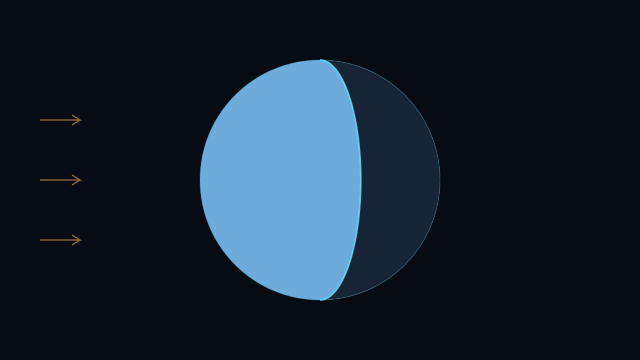
Not an ending
The word means "the thing that terminates", in the sense of forms a boundary. It has no connection to anything finishing, to the end of an eclipse, or to the film. It is one of the easiest terms here to mistranslate for exactly this reason.
Why it matters for an eclipse
An eclipse happening near the terminator is one seen with the Sun very low. That has real consequences:
- The Sun may be behind hills, buildings or haze that would be no obstacle at a higher altitude.
- The umbra strikes the ground at a shallow angle, so its footprint is stretched into a long ellipse and races across the surface much faster.
- Refraction near the horizon distorts the disc noticeably.
Every eclipse track begins and ends on the terminator, because that is where the shadow first touches and last leaves the sunlit face of the Earth. Sunrise and sunset are where the path starts and stops.
The second ring
The globe draws a fainter circle outside the terminator. That one is the astronomical twilight boundary — the Sun 18° below the horizon — and between the two lies the band where the sky is neither properly lit nor properly dark. It is drawn because it is the honest edge of "night": inside the terminator the Sun has set, but the sky does not finish darkening until the fainter ring passes over.
Related
Updated 13 August 2026.