EN ▾
Umbra — the core of the Moon's shadow
The umbra is the part of the Moon's shadow within which the Sun is completely hidden. Where it touches the Earth there is a total eclipse, and nowhere else.
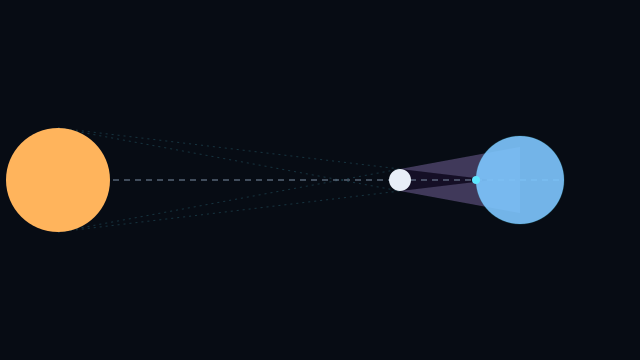
An umbra is the core of any shadow — the region from which the light source is completely hidden. Here it means the Moon's: the cone of full shadow behind it, from which no part of the Sun's disc can be seen at all. Where that cone falls on the Earth, there is a total eclipse. Where it does not, there is not.
How small, and how fast
Measured across the cone, the umbra is at most about 270 km wide where it meets the Earth, and usually a good deal less. Its footprint can be far wider — near sunrise or sunset the cone strikes the surface at a shallow angle and smears into a long ellipse, which is how paths of 400 km and more arise. It is small at all because the cone is very nearly finished by the time it arrives: the Moon and the Sun are almost exactly the same apparent size, so the shadow tapers to nothing at roughly the Earth's distance.
It moves fast. The Moon carries its shadow along at about 1 km/s — some 3,600 km/h — and the ground beneath turns the same way at up to about 1,670 km/h, so the shadow gains on you at a little under 2,000 km/h where it strikes squarely near the equator at local noon. That is the slowest case. Where it strikes obliquely the ground speed climbs steeply, past 5 km/s near the ends of a track. That speed is what limits totality to minutes.
Umbra, penumbra, antumbra
Three regions, three different things seen from inside them:
- Umbra — the Sun is completely hidden. A total eclipse.
- Penumbra — part of the Sun is hidden. A partial eclipse.
- Antumbra — the umbra's continuation past its own tip, from which the Moon appears smaller than the Sun. An annular eclipse.
Related
Updated 13 August 2026.