EN ▾
Totality — the interval when the Sun is completely hidden
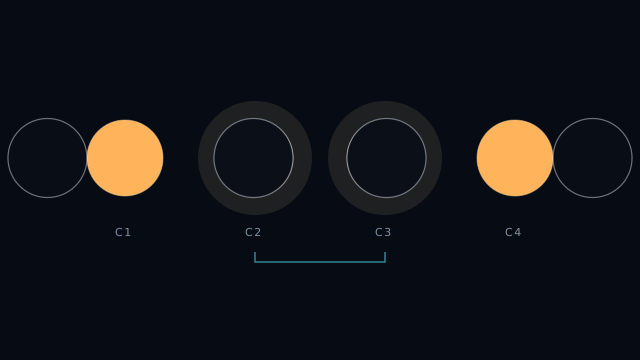
Totality is the interval when the Sun's disc is entirely covered, bounded by second and third contact. The only time it is safe to look unaided.
Totality is the interval during which the Sun's disc is completely hidden by the Moon. It begins at second contact and ends at third contact, and it is the reason total eclipses have a following. Typical centre-line durations run two to four minutes; the theoretical maximum is about seven and a half. The next total eclipse manages 6m 23s at the point of greatest eclipse.
How long it lasts, and why it varies
Duration depends on where you stand. On the centre line the umbra passes overhead squarely and you get the maximum available; at the northern or southern limit it grazes you and totality lasts seconds. The falloff is gentle near the middle and abrupt at the edges, which is why a few kilometres of positioning matters far more at the edge of the path than in its middle.
It also depends on the eclipse. A close Moon and a distant Sun give a wider umbra, and width is what buys time — a perigee Moon actually moves its shadow across the ground rather faster, not slower, so the extra minutes are won in spite of the speed rather than because of it. What genuinely slows the shadow is geography: near the equator around local noon the ground is turning eastwards at close to 0.46 km/s beneath a shadow travelling the same way, and that subtraction is where the longest totalities of all come from.
An annular eclipse has no totality at all — annularity is the corresponding interval there, and the Sun is never completely hidden.
What can be seen
The corona is the point of it — the Sun's outer atmosphere, a million times fainter than the photosphere and, from the ground and without instruments, visible at no other time. Also: the chromosphere as a red rim in the first and last seconds, prominences, the brighter planets, and a 360° twilight around the horizon.
The unaided eye is safe only between second and third contact, and not one second either side. When the first bead of photosphere returns at third contact, the filters go back on.
Related
Updated 13 August 2026. The dates and durations on this page are recomputed with every weekly rebuild.