EN ▾
Annularity — the interval when the ring is complete
Annularity is the interval when the Moon sits wholly inside the Sun's disc and a full ring shows. Bounded by second and third contact, and never safe unaided.
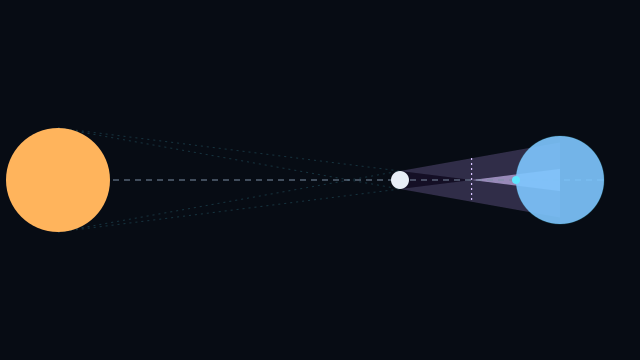
Annularity is the interval during which the Moon sits entirely inside the Sun's disc and an unbroken ring of photosphere is showing all around it. Like totality it is bounded by second and third contact, and those contacts are defined the same way — the moments of internal tangency.
The same word, a different experience
Structurally annularity is the exact counterpart of totality: the same alignment, the same contact definitions, the same shape of duration curve along the track. Experientially it has almost nothing in common with it.
The ring is bright. Around a tenth of the Sun's surface is still showing at mid-annularity — obscuration peaks at roughly 0.85 to 0.95, not at 1 — and a tenth of the Sun is a great deal of light. It is enough to keep the sky blue, the corona invisible and the daylight broadly intact. What you get is a curious flattening and sharpening of the light and, through a filter, a striking shape.
How long it lasts
Annularity runs from a few seconds at the limits to two or three minutes on a typical centre line, and at the extreme to about twelve and a half minutes — comfortably longer than the seven and a half that bounds totality. The reason is mostly speed rather than width: the longest annular eclipses happen with the Moon near apogee, where it moves slowest along its orbit, so its shadow crosses the ground more slowly and lingers. The antumbra is also a little wider than an umbra, up to about 300 km against 270, but that is the smaller of the two effects.
Near the edges of the path the ring is not complete: it thins on one side, breaks, and gives Baily's beads just as a total eclipse does at its own limits.
Annularity is not a safe interval. A complete ring of photosphere is still the photosphere. Filters stay on from first contact to fourth.
Related
Updated 13 August 2026.