EN ▾
Baily's beads — sunlight through the valleys of the Moon
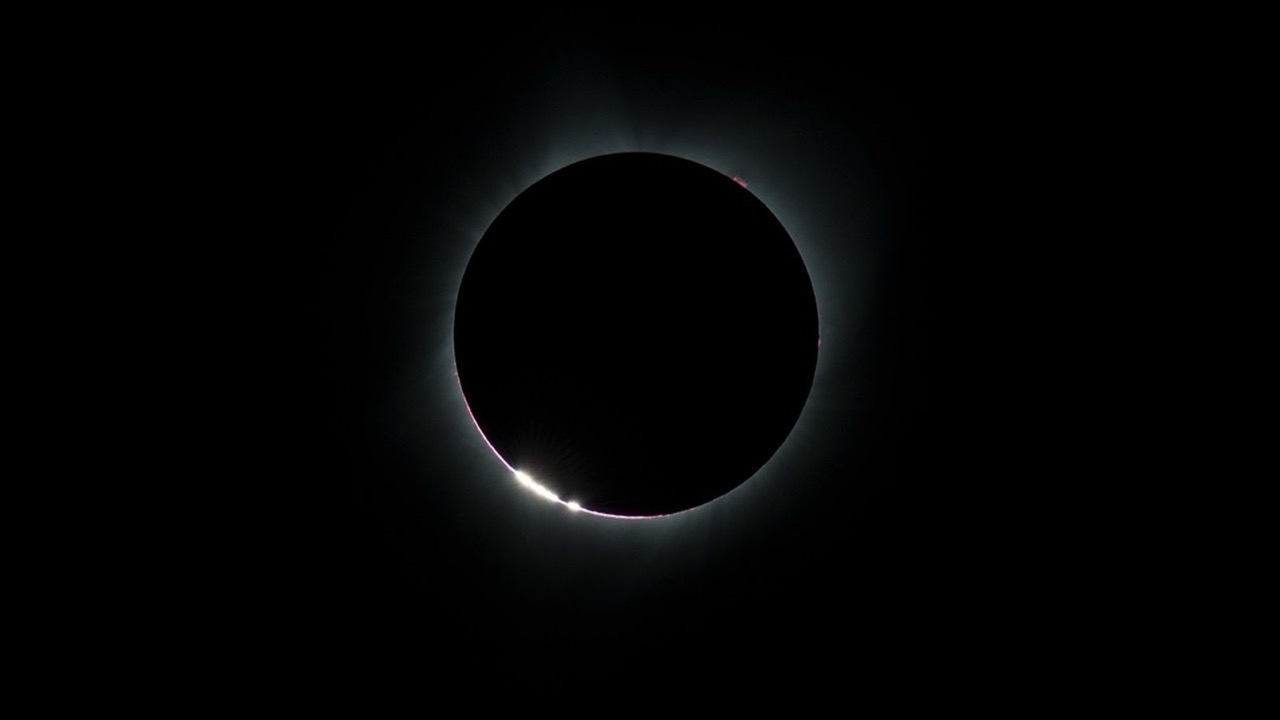
Baily's beads are the points of sunlight streaming through valleys on the Moon's edge in the seconds around second and third contact.
Baily's beads are the brilliant points of sunlight that appear around the Moon's dark edge in the last seconds before totality and the first seconds after it. They are the photosphere seen through the valleys of the lunar profile, while the peaks either side have already covered it. They belong to annularity just as much: the ring breaks into beads at the internal contacts of an annular eclipse too, which is where Francis Baily saw and described them, at the annular eclipse of 15 May 1836. The name has been his ever since — one l, and the possessive of Baily, not Bailey.
Why the Moon's edge does this
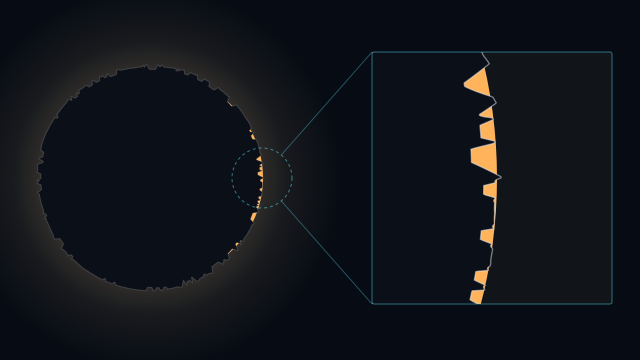
Because it is a landscape in profile — the property of the Moon's limb that page describes, arriving here as an effect you can watch. Relief of one to three kilometres on a disc 3,474 km across is nothing at all until the very last moment, when that roughness is suddenly all that is left of the Sun.
Most of it is craters. A crater sitting on the edge is cut through in cross-section, so it presents a bowl between two raised rims, and that shape is what does the work: the rims reach the Sun's edge first and cut the light, while the floor between them is still short of it and goes on shining. That is a bead. Isolated summits close the gaps in the same way, and the vanishing sliver breaks into a line of separate points that wink out one at a time as the last floors are covered.
The sequence at second contact runs crescent, then a line of beads, then a single one; that last surviving bead, blazing against the ring of inner corona already emerging around the Moon, is the diamond ring. At third contact the same sequence runs backwards, the diamond ring first.
Where they last longest
Near the northern or southern limit of the path. There the Moon's edge is grazing the Sun's rather than crossing it squarely, so the same valleys stay aligned with the photosphere for many seconds instead of an instant, and the beads become the main event rather than a transition.
That is a real trade and some observers make it deliberately: a prolonged bead display in exchange for the corona, and for a much higher chance of seeing nothing at all if the position is a kilometre out.
The beads are photosphere. Filters come off when the last one has gone, not while any remain, and they go back on at the first hint of the next — which at third contact is the most dangerous moment of the eclipse, because the eye is fully dark-adapted.
Why this app does not predict them
Contact times here are computed from a smooth Moon. Predicting the beads means knowing which part of the lunar profile is doing the covering, which depends on the observer's exact position and on a terrain model this app does not carry — so no bead is forecast anywhere on this site, and the contact times either side of totality are the smooth-disc ones.
That is the smaller of two reasons not to plan a graze from these numbers. The larger is that the positions behind them come from truncated series with no correction for the Earth's variable rotation, which places the path to within a couple of hundred kilometres rather than to the metre. For the limits, where a kilometre decides whether there is anything to see, use a limb-corrected source.
Related
- Second contact
- Third contact
- Limb
- Northern and southern limits
- Annularity
- How to watch a solar eclipse without hurting your eyes
Updated 13 August 2026.