How to watch a solar eclipse without hurting your eyes
A certified filter for every moment except totality itself, and nothing else will do. Sunglasses, smoked glass, exposed film and phone screens are not filters, and the danger is silent.
The Sun is as dangerous to look at during a partial eclipse as it is on any other day. It does not become safer because most of it is covered — the remaining crescent is the same photosphere at the same brightness, and there is simply less of it. What changes is that an eclipse gives you a reason to stare, and the discomfort that normally stops you is not there.
The retina has no pain receptors. Solar retinopathy is painless while it happens and its symptoms appear hours later, by which time the damage is done. Nothing about the experience tells you to stop.
What is and is not a filter
A safe solar filter transmits about one part in a hundred thousand of the visible light and blocks the infrared and ultraviolet as well. Certified eclipse glasses and hand-held solar viewers do this; the standard to look for is ISO 12312-2.
Nothing improvised does. The list below is not a list of things that are worse — it is a list of things that offer effectively no protection at all:
- Sunglasses, however dark, and any number of pairs stacked
- Smoked glass, exposed photographic film, X-ray film
- A phone screen, a welding mask below shade 14, a CD
- Looking at the reflection in water, or through cloud, or at sunset
The last is the one people get wrong most often. A Sun dimmed by haze or low altitude is dimmer in the visible, which removes the flinch reflex while leaving the infrared largely intact.
The one exception, and its exact boundaries
During totality — and only during totality — the Moon covers the photosphere completely, and it is safe, and necessary, to look with the naked eye. A filter during those two minutes shows you nothing at all: the corona is about as bright as a full moon.
The boundaries are second contact and third contact, and they are sharp. The filter comes off when the last of the photosphere goes and must be back on the instant it returns — which is announced, at both ends, by Baily's beads breaking up along the lunar limb.
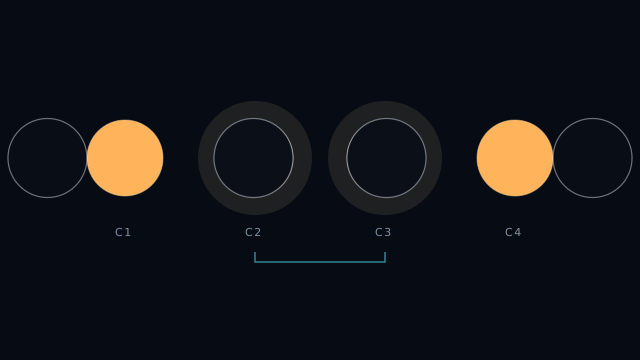
An annular eclipse has no such window. The Moon never covers the Sun completely, so the ring that remains is full-brightness photosphere and the filter stays on from beginning to end. The same is true of every partial eclipse, however deep.
Projection, which needs no filter at all
The oldest method is still among the best and cannot damage anything: let the Sun shine through a small hole onto a surface a metre or two behind it and look at the image, not the Sun. A kitchen colander, a straw hat, or the gaps between the leaves of a tree will all do it — during a deep partial eclipse a tree throws hundreds of overlapping crescents onto the ground, which is one of the strangest and most memorable things about the whole event.
Related
Updated 25 August 2026.