EN ▾
Partial eclipse — when the Moon covers part of the Sun
A partial eclipse is one where the Moon covers only part of the Sun. It is what most of the world sees at any eclipse, and for about a third it is all there is.
A partial solar eclipse is one in which the Moon covers part of the Sun's disc and no more. This is by far the most commonly seen kind, for two separate reasons: it is what everyone inside the penumbra but outside the narrow central track sees during a total or annular eclipse, and it is the whole of some eclipses, where the shadow axis misses the Earth entirely.
Observers inside the track see partial phases too — an hour or so of them either side, between first contact and second, and again between third and fourth. The partial phase is not the consolation prize; it is most of every eclipse, everywhere.
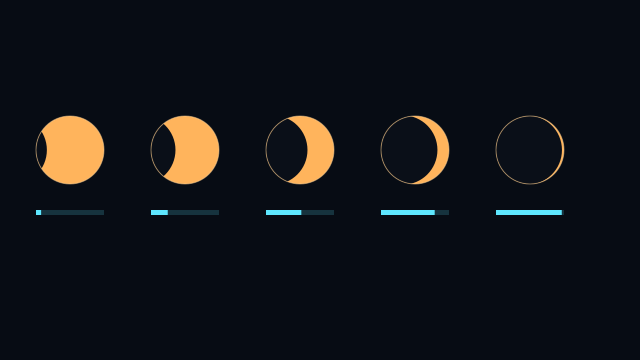
Why it goes unnoticed
A partial eclipse is a poor spectacle, and the reason is the eye rather than the sky. Human vision adapts over an enormous range and does so continuously, so a slow dimming over an hour registers as nothing at all. People routinely fail to notice an 80% eclipse happening above them.
What can be noticed, if you know to look: the light goes strangely sharp-edged, shadows become crisper as the Sun narrows to a crescent, and gaps between leaves project dozens of little crescents onto the ground.
Every moment of a partial eclipse requires certified eclipse filters. There is no safe interval, because part of the photosphere is showing throughout — which is exactly what makes it a partial eclipse.
Partial-only eclipses
About a third of solar eclipses are partial everywhere — 35% of the eleven and a half thousand in Espenak and Meeus's five-millennium canon, against roughly two thirds that are central. The Moon's shadow passes above or below the Earth, clipping the polar regions with its outer edge, and no central eclipse occurs anywhere. These have no path and no duration, so this app gives them a date and a worldwide row but no track on the globe and no corridor to stand in.
Even a partial-only eclipse can be deep: the magnitude of the best-placed eclipse of this kind runs to about 0.99, which is a thin crescent and still not darkness.
Related
Updated 13 August 2026.