EN ▾
Magnitude — the fraction of the Sun's diameter covered
Eclipse magnitude is the fraction of the Sun's diameter the Moon covers. It is a different number from obscuration, and means something else for a star.
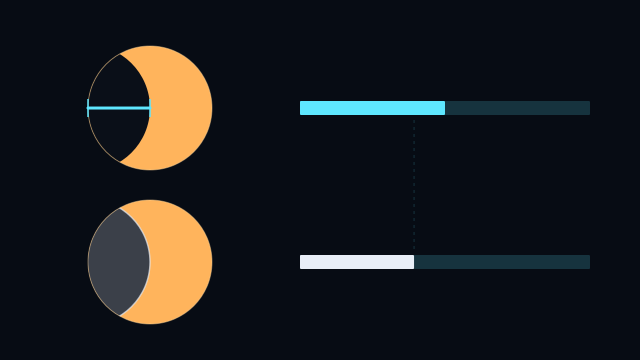
Magnitude is the fraction of the Sun's diameter that the Moon covers — a measurement straight across the disc, not over its surface. This app shows it alongside obscuration, and the two are different numbers describing the same instant.
Why it is always the larger of the two
Short of totality, magnitude is bigger than obscuration, always. The reason is not that area grows faster than width — it is that the covered region is a lens, a sliver bounded by two arcs, while the Sun's widest chord runs through the part still showing. Taking these to be two discs of the same apparent size:
| Sun's diameter covered | Magnitude | Obscuration |
|---|---|---|
| A quarter | 0.25 | 0.14 |
| Two fifths | 0.40 | 0.28 |
| Half | 0.50 | 0.39 |
| Three quarters | 0.75 | 0.69 |
| Nearly all | 0.95 | 0.94 |
| All | 1.00 | 1.00 |
The gap is widest around magnitude 0.38, where it reaches about 0.115, and closes steadily after that; the two meet only at the ends. Quoting one number and calling it the other overstates a partial eclipse by a noticeable margin — the kind of error that turns an unremarkable 39% into a headline-worthy "half the Sun gone".
Why the app still needs it
Magnitude does not stop at 1. Once the Moon's disc is wider than the Sun's it keeps climbing — 1.02, 1.05, and at the extreme about 1.08 — measuring how comfortably the Sun is covered rather than merely whether it is. Obscuration is stuck at 1 for the whole of totality; magnitude is not, so it is the quantity this app climbs when it searches for the best-placed point inside a country, where every candidate is already fully eclipsed and obscuration cannot tell them apart.
It is also what decides the kind of eclipse. A central eclipse with magnitude just under 1 is annular — the Moon is too small to cover the Sun and leaves a ring. Just over 1 and it is total. The whole distinction sits within a few percent of this one number, which is the coincidence described under apparent radius.
Magnitude means something completely different when applied to a star, where it is a measure of brightness on a scale that runs backwards — a magnitude 1 star is brighter than a magnitude 5 one. The two senses share nothing but the word. Nothing on this site uses the stellar sense.
Related
Updated 13 August 2026.