EN ▾
Obscuration — the fraction of the Sun's area covered
Obscuration is the fraction of the Sun's area hidden by the Moon. It is the number that matches how dark an eclipse feels, and it is not the same as magnitude.
Obscuration is the fraction of the Sun's area that the Moon covers, at one moment and from one place. It runs from 0 when the discs are clear of each other to 1 when the Sun is completely hidden, and it is the number this app leads with everywhere.
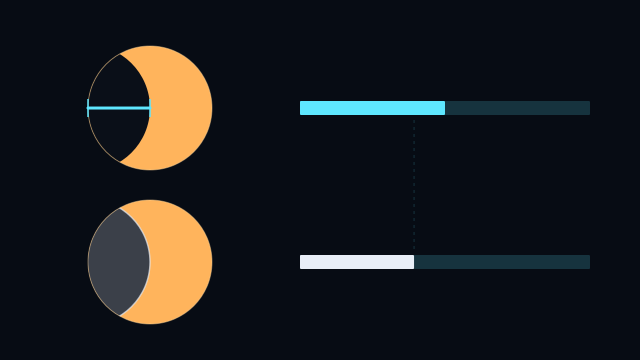
Why this is the number that matters
It is the closest of the available measurements to what a person standing under the eclipse actually experiences. Light falling on the ground is proportional to the area of Sun still showing, so obscuration is very nearly a reading of how much daylight has been taken away.
Very nearly, and not exactly, for two separate reasons. The physical one is limb darkening: the Sun's rim is dimmer than its centre, and the Moon takes the rim first, so early in an eclipse obscuration slightly overstates how much light has actually gone. The human one is larger. The eye adapts, and it adapts far faster than the eclipse proceeds — which is why a partial eclipse of 80% obscuration looks to most people like an ordinary bright afternoon, and why people who were not told one was happening routinely fail to notice. The last few percent do all the visible work.
Obscuration of 0.999 is not "almost totality". The remaining sliver of photosphere is still thousands of times brighter than the corona, the sky stays blue, and nothing of what makes a total eclipse worth travelling for is visible. The difference between 0.999 and 1 is the difference between the two events.
What it cannot do
Obscuration is flat at 1 across the whole umbra. Every observer inside the path of totality reads exactly 1 for the whole of totality, whether they are on the centre line with four minutes to enjoy or at the very edge with four seconds.
That makes it useless for telling places inside the path apart, which is why the search that finds the best-placed point in each country climbs magnitude rather than obscuration: magnitude keeps rising past 1 as the Moon covers the Sun more comfortably, so it still has a gradient where obscuration has run out of range.
The countries panel itself is then ranked on obscuration, with solar altitude breaking the ties — and it is altitude that does the real work of separating the block of countries all reading 100%, because an eclipse high overhead is a different proposition from the same eclipse just clearing the horizon.
At an annular eclipse obscuration never reaches 1 at all. It flattens out at roughly 0.85 to 0.95 through annularity, because the ring never stops shining — so a reading that peaks at 92% and stays there is not a near miss, it is what an annular eclipse looks like.
Where to see it
The large percentage in the readouts panel is obscuration at the current instant, at your location. The countries panel uses the same quantity to decide which countries an eclipse touches at all, at a threshold of 0.5% — the same level the map traces its outer limit at, so the list and the map agree about what "touched" means. That contour stands in for the penumbra's true edge, which is at 0% and cannot be drawn: a boundary where the Sun is infinitesimally nicked is not something a sampling grid can find.
The app's own label for this quantity in the readouts is convergence, which is the same number under a friendlier name.
Related
Updated 13 August 2026.