EN ▾
Centre line — where totality lasts longest
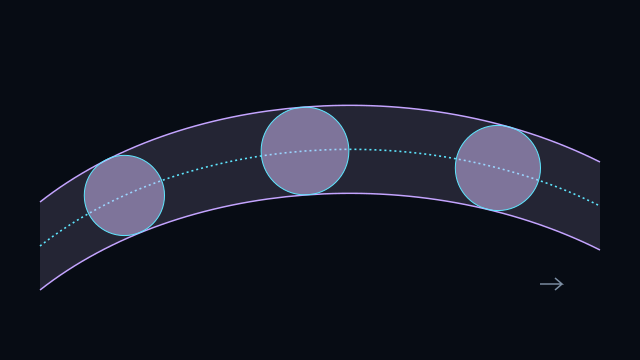
The centre line runs down the middle of the path of totality, where the umbra passes most squarely overhead and totality lasts longest.
The centre line is the line down the middle of the path of totality — the ground track of the shadow axis itself. Standing on it gives the longest totality available at that point along the path. The longest of the whole eclipse falls at one particular place on it, near greatest eclipse.
How much it is worth
Less than people expect near the middle, and far more than they expect near the edge. The shadow's footprint is very nearly a circle, and the time you spend inside it is the length of the chord you cut across it — so the duration follows an ellipse, costing almost nothing at first, then progressively more, then everything.
| Position across the path | Share of the centre-line duration |
|---|---|
| On the centre line | 100% |
| A quarter of the way to the edge | 97% |
| Halfway to the edge | 87% |
| Three quarters of the way | 66% |
| At the limit | 0% |
So on a 150 km path — 75 km from the centre line to either limit — a twenty-kilometre error costs a few seconds. A fifty-kilometre error costs a third of the eclipse, and seventy kilometres costs nearly two thirds.
This is the idealisation, not the law: it assumes a circular footprint crossing squarely, and near the ends of a track, where the shadow strikes at a shallow angle, the real footprint is a stretched ellipse and the rule loses its grip.
What to do with that
Aim for the middle, but do not chase it at the expense of the weather — the difference between the centre line and a third of the way out is a handful of seconds, and the difference between clear sky and cloud is all of it. The usual advice among people who have done this more than once is to treat the middle half of the path as equally good and spend the remaining effort on finding a hole in the cloud.
Related
- Path of totality
- Northern and southern limits
- Totality
- Corridor
- Greatest eclipse
- How to read an eclipse path map
Updated 13 August 2026.