EN ▾
Path of totality — the track you have to be standing in
The path of totality is the strip the Moon's umbra traces across the Earth. Inside it there is a total eclipse; a kilometre outside it there is not.
The path of totality is the track the umbra sweeps across the Earth's surface during an eclipse. It is usually one to three hundred kilometres wide — 2026's is about 290 km, 2027's about 260 — and can be thousands of kilometres long. It is the single most consequential fact about any total eclipse: stand inside it and you see one, stand outside it and you do not.
The phrase gets used loosely for both the strip and the line down its middle. Where the two need telling apart, this app calls the strip the corridor and the line the centre line.
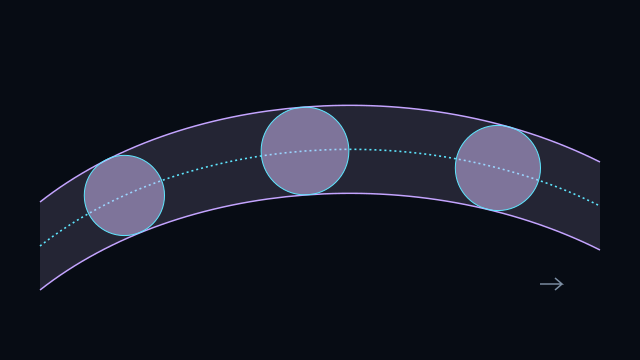
The edge is a hard edge
The duration is continuous — it shrinks smoothly to zero at the limit — but the outcome is not. Crossing the limit takes you from a few seconds of totality to none at all, and "none at all" means a 99.9% partial eclipse: a completely different and largely unremarkable event, not a slightly worse version of the same one. There is no partial credit. The margin for error on eclipse day is measured in kilometres.
The corollary is that being deep inside the path is worth much more than being just inside it. Duration falls off slowly near the centre line and then very fast near the edges.
To check a particular spot, put the observer there: the app's own timings are computed from your coordinates, and a location inside the corridor will show a C2 and a C3.
What decides its width
Three things. A close Moon casts a wider umbra, so a total eclipse near perigee gives a broader path and a longer totality. A distant Sun helps too — near aphelion in July the Sun is at its smallest and is covered more comfortably. Between them these set a ceiling: measured across the cone, with the shadow striking squarely, the umbra is at most about 270 km wide.
The third is the angle of incidence, and it is why real paths exceed that figure. Where the shadow strikes obliquely — near the start and end of every track, and throughout a high-latitude one — the ellipse it cuts on the ground is stretched well beyond the cone's own width, past 400 km in extreme cases. This is what makes 2026's path as broad as it is. It buys no extra time: the shadow is racing across the surface there, several times its usual pace.
Related
Updated 13 August 2026.