EN ▾
Northern and southern limits — the edges of the path
The limits are the two edges of the path, where the central phase shrinks to nothing. A prediction near one is far more sensitive to your exact position.
The northern and southern limits are the two lines along which the Moon's disc is exactly tangent to the Sun's from the inside — the outer edge of the ground the umbra or antumbra touches. Stand a metre inside one and the Sun is covered, briefly; a metre outside and it never quite is. Between them there is totality — or annularity, for an annular eclipse, where the same two lines bound the ring. Outside them there is a very deep partial eclipse and nothing else.
They are the two edges of what this app calls the corridor, and the app's own legend calls them the limits of centrality — worth keeping distinct from the partial limits, a quite different line marking the outer boundary of any visible partial phase at all.
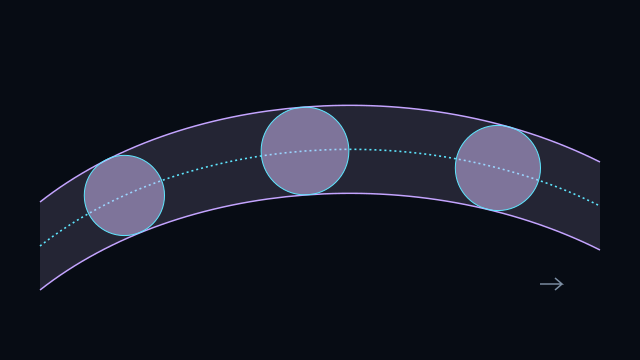
The most position-sensitive place to stand
Near a limit, small distances matter enormously. Duration falls away as the square root of the distance from the edge, so the collapse is steepest exactly where you are standing: on a 150 km path with four minutes on the centre line, a kilometre inside the limit still buys about forty seconds, and a hundred metres inside buys twelve. A prediction there is only as good as your knowledge of where you are — and only as good as the assumptions behind the prediction.
That second part is worth dwelling on. This app models the Moon as a smooth disc, and the real Moon has mountains. Near the edge the deciding factor is whether sunlight is streaming through a particular lunar valley, which a smooth-disc model cannot know. That is on top of a much larger term: these positions come from truncated series with no correction for the Earth's variable rotation, so the whole path is placed to within a couple of hundred kilometres rather than to the metre. This is the wrong tool for choosing a spot at the edge. Anyone deliberately grazing the limit should use predictions built from the lunar profile — Espenak's canon, or one of the limb-corrected graze charts.
The narrow strip either side of a limit has a name of its own: the graze zone.
Why anyone would go there deliberately
For the beads. At the very edge of the path the last fragments of photosphere linger along the Moon's limb for many seconds instead of a moment, producing a prolonged display of Baily's beads that is not visible from the middle of the path. It is a trade: a spectacular edge phenomenon in exchange for the corona, and for a much higher chance of getting nothing at all.
Related
Updated 13 August 2026.