EN ▾
Is it worth travelling to see totality?
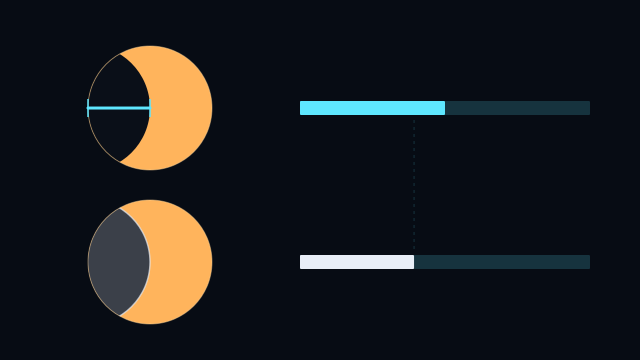
A 99% partial eclipse and a total one are not the same event at different strengths. The difference is not a matter of degree, and it arrives in the last few seconds.
The honest answer is yes, and the reason is not enthusiasm. A 99% partial eclipse and a total eclipse are different events, and the gap between them is not a gap of degree.
The photosphere is roughly 400,000 times brighter than the corona around it. One per cent of it is still 4,000 times brighter than everything a total eclipse reveals, which means that at 99% you are looking at a slightly odd afternoon: the light has gone strange and flat, shadows have sharpened, the temperature has dropped a few degrees, and the Sun is still far too bright to look at. At 100% the sky goes to twilight, the corona appears around a black disc, bright stars and planets come out, and the horizon glows sunset-coloured in every direction at once.
The last one per cent is not one per cent of the experience. It is most of it.
How far is "worth it"
The path of totality is typically 150–250 km wide, and its limits are sharp — the difference between inside and outside is a few kilometres of road. Every pair page on this site gives the distance and bearing from that city to the centre line, which is the number the question actually turns on.
For most eclipses, most people inside the 90% contour are within a few hours' drive of totality. That is a very different proposition from a flight to the other side of the world, and it is the case where the answer is unambiguous.
Duration is not the only thing worth optimising
The centre line gives the longest totality, and the difference between the centre and the edge of the path can be a factor of two or more. But a few minutes at the edge of the path is still totality, and a clear sky at the edge beats cloud on the centre line every time.
Two things are worth weighing above duration:
- The Sun's altitude. An eclipse with the Sun ten degrees up needs a flat, open horizon and is at the mercy of any cloud bank sitting on it. One near the zenith needs only somewhere to stand.
- Mobility on the day. A location you can leave — a car, a road running along the path rather than across it — is worth more than any amount of pre-planning, because the one variable nobody controls is where the cloud is at second contact.
What you cannot get any other way
Any given place on Earth sees totality about once every 375 years on average. That is the whole argument: it is not that a total eclipse is the best thing in the sky, it is that it is the best thing in the sky and it will not come to you.
Related
Updated 25 August 2026.