EN ▾
Antumbra — the shadow beyond the shadow's tip
The antumbra is the umbra's continuation past the point where it converges to nothing. From inside it the Moon looks smaller than the Sun: an annular eclipse.
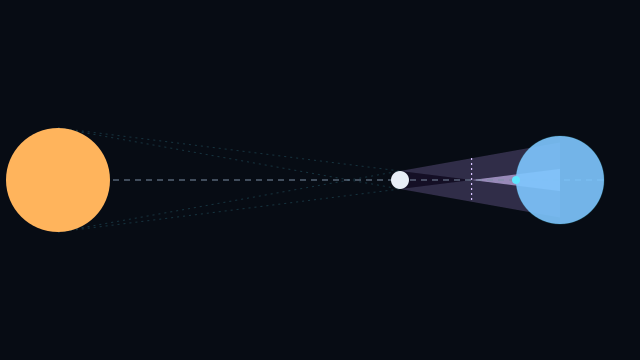
The antumbra is what lies beyond the tip of the umbra. The umbral cone converges to a point; past that point the same two tangent lines open out again, and the region they enclose is the antumbra. An observer inside it sees the Moon entirely within the Sun's disc, with a ring left over — an annular eclipse.
Why it exists at all
Because the Moon's distance varies. The umbral cone averages about 374,000 km long, and the Moon sits between roughly 356,000 and 407,000 km away. The cone has to reach not the Earth's centre but its surface, which is one Earth radius nearer — so the tip falls short whenever the Moon is beyond about 380,000 km.
That threshold sits below the Moon's mean distance of 384,400 km, which is the fact worth carrying away: falling short is the ordinary case. Annular eclipses are the commoner kind, 33% of the total against 27% for total eclipses. A total eclipse needs a nearer-than-average Moon.
The cone's length varies too, by about ±2% over the year as the Earth's distance from the Sun changes — a smaller effect than the Moon's, but the same size as the margin it is competing with, which is why January favours annular eclipses slightly. The margin being so fine is why both kinds are common and why some single eclipses manage to be both along different parts of one track — the hybrid case.
Where it lands, the antumbra is up to about 300 km across, a little wider than an umbra's 270 km.
The name
The prefix is ante-, "before", not anti-, "against" — so the word means something like "fore-shadow" rather than "anti-shadow". The naming is not especially transparent, and it is easiest to hold onto by the geometry rather than the Latin: the antumbra is simply the umbra's cone carried on past its own tip.
It is the one of the three shadow terms most people have never needed. It appears nowhere in this app's interface — the layers and readouts speak of corridors and convergence — so this page is the only place you will meet the word here.
Related
Updated 13 August 2026.