EN ▾
Central eclipse — total or annular, as opposed to partial
A central eclipse is one whose shadow axis strikes the Earth, so somewhere there is a track to stand in. It is the dividing line this app is built around.
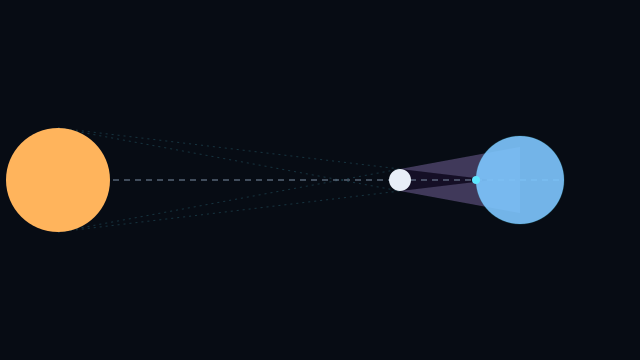
A central eclipse is one in which the shadow axis — the line from the Sun's centre through the Moon's — actually meets the Earth. Every central eclipse is either total or annular, and sometimes both at different points along its track.
Why the distinction runs through everything here
It is the line between an eclipse that has somewhere to go and one that does not. A central eclipse has a path, a centre line, a duration at greatest eclipse and a place worth travelling to. A partial-only eclipse has none of these — there is no track, because the cone never lands.
This app draws corridors, limits and ground tracks only for central eclipses, and the totalities list contains only the total ones. Partial-only eclipses still appear in the list of what is visible from your location, because from your location they are perfectly real.
Hybrid eclipses
A small number of central eclipses change kind along their track — most often annular at one or both ends and total in the middle, though the reverse happens too. The Earth is round, so an observer near the middle of the path is closer to the Moon — by up to one Earth radius — than one near either end, and that is occasionally enough to bring the umbra into contact with the ground where it had fallen short. About 5% of all solar eclipses are hybrid.
Two thirds of solar eclipses are central: roughly 27% total, 33% annular and 5% hybrid, against 35% that are partial everywhere. The quantity the test turns on is gamma, the axis's least distance from the Earth's centre measured in Earth radii — under about 0.997 and the axis lands. Very close to that boundary the axis can miss while the cone's edge still grazes a polar region, giving a non-central total or annular eclipse; those are rare, and this app draws no track for them.
Related
Updated 13 August 2026.