EN ▾
Shadow axis — the line the whole eclipse hangs on
The shadow axis runs from the Sun's centre through the Moon's and onwards. Whether it strikes the Earth separates a central eclipse from a partial one.
The shadow axis is the straight line from the centre of the Sun through the centre of the Moon, extended onwards past it. It is the axis of symmetry of the whole shadow — the umbra and penumbra are both cones around it.
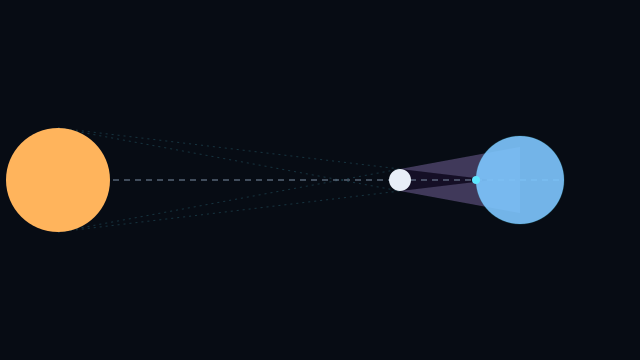
The one question it answers
Does it hit the Earth?
- Yes — the eclipse is central. There is a track on the ground, a centre line, a duration and somewhere to travel to.
- No — the eclipse is partial almost everywhere. Usually nobody sees more than a bite out of the Sun, though when the axis misses only narrowly the cone's edge can still graze a polar region and give a small area a brief totality — a non-central total or annular eclipse, catalogued separately and genuinely rare.
Around two thirds of solar eclipses fall on the first side of that line: in the five millennia Espenak and Meeus catalogue, roughly 27% are total, 33% annular and 5% hybrid, against 35% that are partial everywhere. This app uses exactly this test to decide whether an eclipse gets a path drawn for it — which means it draws no path for the rare grazing case above.
The quantity behind the test has a name: gamma, the axis's least distance from the Earth's centre in Earth radii. The eclipse is central when |γ| is below about 0.997, and there is no eclipse at all beyond about 1.55.
Where it meets the ground
When the axis does meet the Earth's surface, that point is the centre of the umbra at that instant — the middle of the track. Following it over the course of the eclipse traces the centre line. At the moment of greatest eclipse it is passing as close to the Earth's centre as it will get, and that ground point is the coordinate an eclipse is catalogued under. A partial eclipse still has a moment of greatest eclipse — the axis has a closest approach whether or not it lands — but no ground point of its own, which is why this app draws it a date and no track.
Related
Updated 13 August 2026.