EN ▾
Subsolar point — where the Sun is directly overhead
The subsolar point is the place on Earth with the Sun exactly overhead. During a central eclipse it sits within about 100 km of the sublunar point.
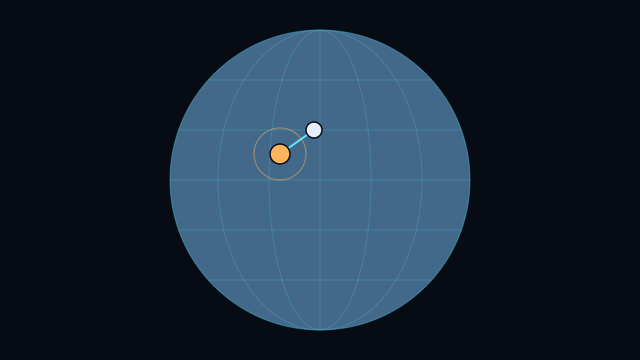
The subsolar point is the point on the Earth's surface directly beneath the Sun — the one place at any instant where the Sun is exactly overhead, at an altitude of 90°.
Where it goes
It runs westwards around the Earth once a day at about 1,670 km/h where it is on the equator, and more slowly the further from it — the ground speed falls off with the cosine of the latitude. Over the year it drifts north and south between the two tropics, which is what defines them. This app draws its track as the sun path layer.
Its part in an eclipse
During a central eclipse the subsolar point and the sublunar point very nearly coincide, and the small distance between them is the entire event. The threshold is about 106 km: closer than that and the shadow axis strikes the Earth and somebody is standing in totality. That number comes from the Moon's parallax, not from the width of the shadow — the two happen to be comparable, but it is the axis reaching the globe that decides the matter, and a narrow-path eclipse is still central.
The closer they come, the closer the eclipse is to greatest eclipse — that instant is defined by the axis passing nearest the Earth's centre, which is the same statement made from the middle of the planet rather than from its surface. The two are proportional: the gap in kilometres is about 106 times gamma, the axis's miss distance in Earth radii.
Related
Updated 13 August 2026.