EN ▾
Sublunar point — where the Moon is directly overhead
The sublunar point is the place on Earth with the Moon at the zenith. Its distance from the subsolar point decides whether an eclipse is happening at all.
The sublunar point is the point on the Earth's surface directly beneath the Moon — where the Moon stands at the zenith. It is the exact counterpart of the subsolar point, and this app draws its track as the moon path layer.
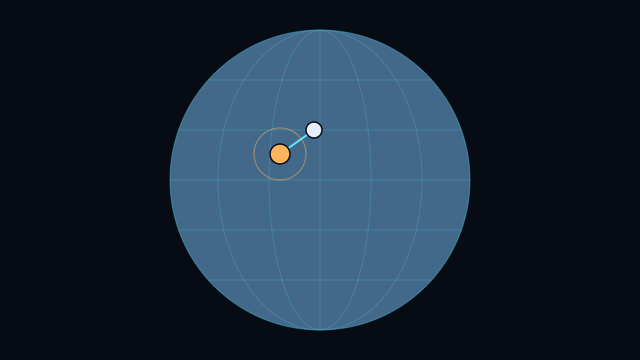
The gap is the eclipse
Take the distance between the sublunar and subsolar points. When it is large, the Moon is nowhere near the Sun in the sky and nothing is happening. The scale is much tighter than most people expect, because the gap is the Sun–Moon angle laid on the ground at 111 km per degree, and the discs are only half a degree wide:
- Below about 165 km — somebody somewhere is seeing a partial eclipse.
- Below about 106 km — the shadow axis meets the Earth, the eclipse is central, and there is a track on the ground.
At the total eclipse of 8 April 2024 the two points were about 36 km apart at greatest eclipse. A gap of a few thousand kilometres is not a near miss; it is an ordinary fat crescent Moon, days away from new, with no eclipse anywhere.
This is the ground-level statement of what angular separation says in the sky — with one difference worth keeping straight. The gap between subpoints is geocentric, measured as if from the centre of the Earth, while the separation you actually see is topocentric and can differ by up to a degree because of the Moon's parallax. That difference is larger than every threshold above, and it is precisely why an eclipse is total for one observer and partial for another while the two markers sit exactly where they are.
Watching the markers converge on the globe view is the most direct way this app offers of seeing an eclipse coming. Do not expect the shadow to land between them: at 2024's gap of 36 km the umbra came down some 2,000 km away.
Why it moves more slowly than the Sun's
The sublunar point circles the Earth in about 24 hours 50 minutes rather than 24 hours, because the Moon moves along its own orbit while the Earth turns and the Earth has to catch up. So it crosses the equator at roughly 1,613 km/h against the subsolar point's 1,670 — a little slower, by about 3%. That extra 50 minutes a day is why the Moon rises later each night, and why the two subpoints drift past each other rather than staying in step.
Related
Updated 13 August 2026.