EN ▾
Angular separation — the quantity every eclipse reduces to
The angle between two directions in the sky. Every eclipse calculation here comes down to comparing it against the Sun's and Moon's apparent radii.
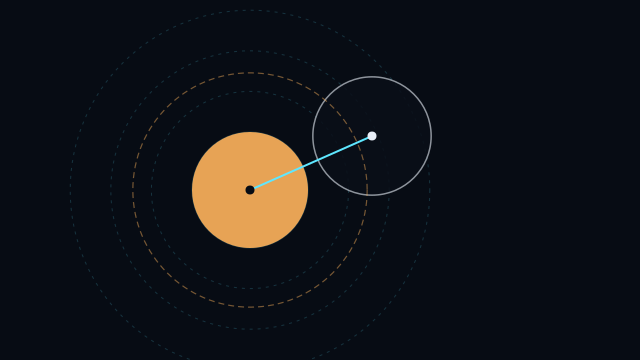
Angular separation is the angle between two directions in the sky — here, between the centre of the Sun and the centre of the Moon as seen from where you are standing. It is measured in degrees, and the discs themselves are only about half a degree across.
The whole calculation, in one comparison
Take the separation s, the Sun's apparent radius R and the Moon's r. Everything else follows:
- s > R + r — the discs are clear of each other. No eclipse.
- s = R + r — first or fourth contact.
- |R − r| < s < R + r — partly overlapping. A partial eclipse, and the overlap area gives the obscuration.
- s = |R − r| — second or third contact.
- s < |R − r| — one disc is wholly inside the other. Which one decides the kind: if r > R the Moon covers the Sun entirely and this is totality; if r < R the Moon sits inside the Sun and this is annularity.
The absolute value matters. Written as R − r the third condition goes negative for every total eclipse, and the list would classify the middle of totality as a partial eclipse. And the last two are not successive stages of one sequence — they are alternatives, chosen by which disc is larger on the day, which is why no eclipse is ever both at the same instant from the same place.
That is the entire eclipse, reduced to one number compared against two others. Everything else this app computes — contact times, obscuration curves, the shape of the corridor — is that comparison run at many instants or at many places.
For scale: R + r is about 0.53°, so the whole eclipse from C1 to C4 occupies barely half a degree of separation, and the Moon closes that at roughly half a degree an hour. At an ordinary new moon the Moon misses by up to about 5° — ten disc-widths — and nothing happens at all.
Why it is worth naming
Because "how far apart" in the sky is not a distance and has no unit of length. The Sun is 400 times further away than the Moon; asking how many kilometres apart they appear is meaningless. An angle is the only thing that can be measured.
Related
Updated 13 August 2026.