EN ▾
First contact (C1) — the beginning of the partial phase
First contact is the moment the Moon's limb first touches the Sun's and the eclipse begins. Nothing is visible to the unaided eye for some time afterwards.
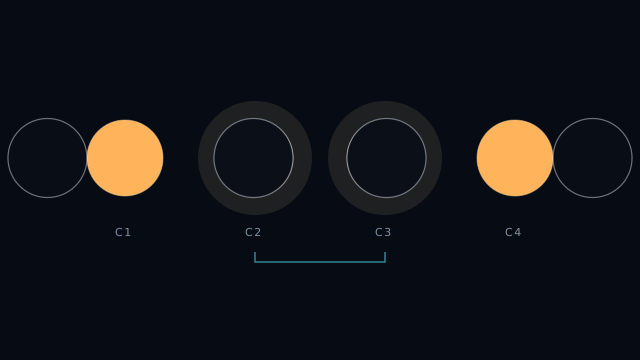
First contact, written C1, is the instant at which the Moon's limb first touches the Sun's from outside. The partial phase begins here. It is the start of the eclipse at your location and nowhere else — an observer a hundred kilometres away has a different C1.
What it looks like
Almost nothing, for a long time — but only to the unaided eye. Through a filter a tiny notch appears at the Sun's edge within seconds and grows steadily; catching it is a small pleasure that lasts about ten seconds and cannot be recovered if missed. Without a filter there is no change worth the name for the best part of an hour. The obscuration is a fraction of a percent for the first minute or two, but the reason nothing looks different for so much longer is the eye rather than the sky: vision adapts continuously, and daylight does not visibly change until roughly three quarters of the Sun has gone.
The wait is a real one. C1 to second contact is typically 70 to 85 minutes, and C1 to fourth two and a half to three hours.
Precision
C1 is the contact least in need of a precise time, which is fortunate, because it is the one any model is least able to give. The tangency is gradual: the two limbs approach at a shallow angle, so the instant is smeared over several seconds however well it is computed. Treat the quoted time as "have the filter on by then" rather than as a stopwatch mark.
The bigger limit is the same for all four contacts and is not about arithmetic. This site assumes a smooth lunar disc, and the Moon's edge is mountains and valleys — see limb. A real contact happens when a real ridge touches the Sun, which can be a second or two either side of where a smooth circle would put it, and more at the limits. Where seconds genuinely matter is second and third contact, which bound something that cannot be looked at safely a moment early. For those, use a source that models the limb profile.
Related
Updated 14 August 2026.