EN ▾
Second contact (C2) — the beginning of totality
Second contact is the moment the Moon's disc moves fully onto the Sun's and totality or annularity begins. The most time-critical instant of an eclipse.
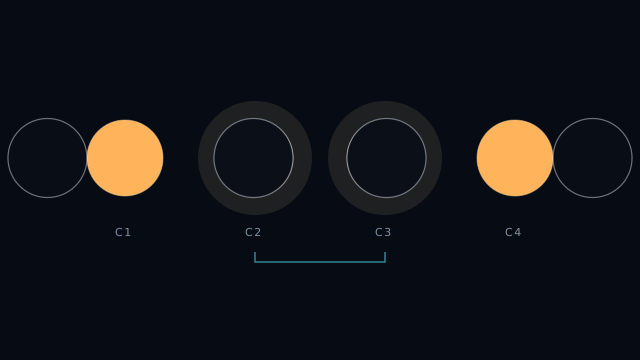
Second contact, C2, is the instant at which the Moon's disc has moved fully onto the Sun's — the moment of internal tangency on the leading edge. Totality or annularity begins here.
The most consequential instant of the event
At a total eclipse, C2 is the moment filters come off. It arrives suddenly: the last thread of photosphere breaks into Baily's beads, those points wink out one by one, the last of them flares as the diamond ring, and then the corona is there.
At an annular eclipse none of that applies and the filters stay on throughout — the ring is photosphere at full brightness. C2 there marks the closing of the ring, not the end of danger.
The whole transition takes a couple of seconds, and everything worth seeing at an eclipse happens on the far side of it. This is why the app quotes C2 to the second, and why the countdown in the header counts to it specifically rather than to "maximum".
Coming off filters even slightly early means looking at the photosphere directly. Wait for the disc to be visibly gone, not for a clock. A stopwatch is a guide; your eyes are the test.
Why the countdown runs to C2, not to maximum
Through totality the obscuration is flat at 1: every moment between C2 and C3 is as covered as every other, so "maximum" names no distinguishable instant. The header countdown therefore runs to C2 and then to C3, the real edges, rather than to a midpoint nothing happens at. (The timings panel still lists a maximum row — it is the right number for a partial eclipse, and harmless for a central one.)
At an annular eclipse the same argument reaches the same place by a different route: obscuration is flat between the internal contacts but sits well below 1, at roughly 0.85 to 0.95, because the ring never stops shining. Flat is what makes the midpoint uninteresting, not the value 1.
Related
Updated 13 August 2026.