EN ▾
Photographing a solar eclipse
A filter on the lens for every phase but totality, one exposure plan written down in advance, and a decision made early about whether to photograph the first one you see at all.
Two pieces of advice come before any of the technical ones, and they are the ones most often skipped.
A solar filter goes on the lens, not on the eye. Concentrated sunlight will destroy a shutter, a sensor or a mirror in seconds, and an optical viewfinder pointed at an unfiltered Sun will do to your retina what a telescope does to paper. The filter belongs on the front of the lens, before the light is gathered, for every phase except totality.
Consider not photographing your first one. Totality lasts two or three minutes and does not repeat. A great many people spend it looking at a screen, get a mediocre photograph of something thousands of people photographed better, and have no memory of the event itself. There is no shame in the second one being the one you shoot.
The partial phases
With a filter on the lens the Sun is an ordinary bright subject: a long lens, a low ISO, and an exposure that puts the disc a stop or so below clipping. The filter's density does the work, so the settings barely change over the hour — set them once and leave them.
At 400mm the Sun is about a quarter of the frame on full-frame; at 2000mm it fills it. Below about 200mm it is a bright dot and you are photographing the landscape with an odd sun in it, which is a perfectly good picture and a much easier one.
Totality
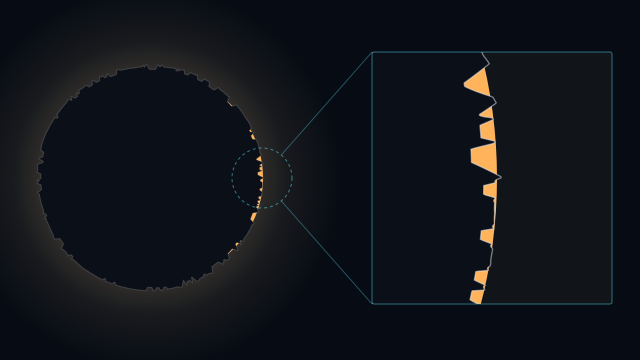
The filter comes off at second contact and goes back on at third, and both moments are announced by Baily's beads breaking along the limb. Take the filter off too early and you overexpose the frame and endanger the sensor; leave it on and you photograph nothing.
The corona spans an enormous dynamic range — the inner corona is thousands of times brighter than the outer — so no single exposure captures it as the eye sees it. The standard approach is a bracket across seven or eight stops, run automatically, and combined afterwards. Write the sequence down and rehearse it; nobody makes good decisions during totality.
The things worth more than a close-up
The tight shot of the corona is the picture everyone takes. Several others are rarer and easier:
- The horizon, 360° of sunset colour, which no close-up conveys and which is what people remember.
- The crowd, which is a genuinely strange and moving subject during totality.
- Crescents under a tree, during the partial phases — hundreds of pinhole images of the eclipsed Sun projected onto the ground.
- A wide frame with the landscape in it, at any focal length, which places the event somewhere rather than isolating it.
What the pages here give you
Everything a plan needs is on the page for your city and that eclipse: the contact times to the second in local time, the Sun's altitude and bearing at each one, and the length of totality where you will be standing. The altitude is the number to check first — an eclipse ten degrees above the horizon needs a very different location from one overhead.
Related
Updated 25 August 2026.