EN ▾
Apparent radius — how big something looks, as an angle
The apparent radius is the angular size of a body as seen from here. That the Sun's and the Moon's overlap is the coincidence total eclipses depend on.
The apparent radius is how large a body looks from where you are, expressed as an angle rather than a distance. The Sun and the Moon both come out at about 16 arcminutes — a bit over a quarter of a degree, so each disc is a little over half a degree wide — and that they agree so closely is the coincidence the whole subject rests on.
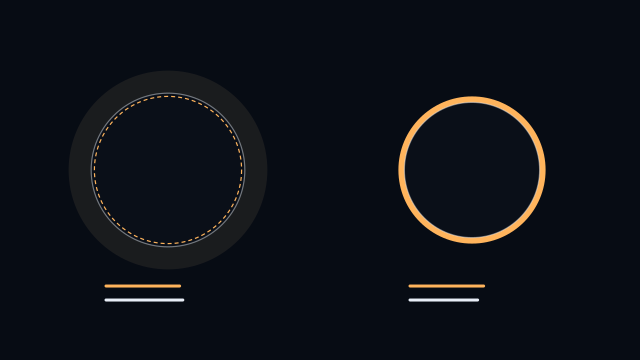
The coincidence
The Sun is about 400 times wider than the Moon and about 400 times further away. There is no reason for this — it is not a consequence of anything, and it is not permanent. It simply happens to be true during the period in which there is anyone here to notice.
Both ranges below are geocentric — as seen from the centre of the Earth, which is the convention almanacs quote. See the last section for what an observer on the surface sees.
| Range, geocentric | |
|---|---|
| Sun's apparent radius | 15.8′ to 16.3′ over a year |
| Moon's apparent radius | 14.7′ at apogee to 16.7′ at perigee |
The ranges overlap, which is why both total and annular eclipses exist. If the Moon were slightly further away every central eclipse would be annular, and nobody would ever have seen the corona.
The ratio of the two is exactly what magnitude measures at a central eclipse: above 1 and the Moon covers the Sun, below and it leaves a ring.
It is slowly ending
The Moon recedes from the Earth by about 3.8 cm a year. In something like 600 million years the last total solar eclipse will occur, and after that every central eclipse will be annular. The same recession means eclipses were more comfortably total in the deep past.
Topocentric, not geocentric
The Moon's apparent radius depends on where on Earth you are: an observer with the Moon overhead is one Earth radius — 1.7% of the distance — closer to it than one seeing it on the horizon, and it looks correspondingly larger. So the geocentric 16.7′ above is really about 17.0′ for someone with a perigee Moon at the zenith.
This app applies that correction to the Moon, which is where it matters; the Sun is 400 times further away and its own parallax is under nine arcseconds, so it is taken geocentrically. That is what makes the contact times location-specific rather than approximate.
Related
Updated 13 August 2026.