EN ▾
Total eclipse — when the Moon covers the Sun completely
A total solar eclipse happens where the Moon's umbra touches the ground — the only kind at which it is ever safe to look at the Sun unaided, and only briefly.
A total solar eclipse is one where the Moon covers the Sun's disc completely, as seen from somewhere on the Earth's surface. That somewhere is a narrow track — the path of totality — and outside it the same event is an unremarkable partial eclipse. The next one is on 2 August 2027.
Why total and not annular
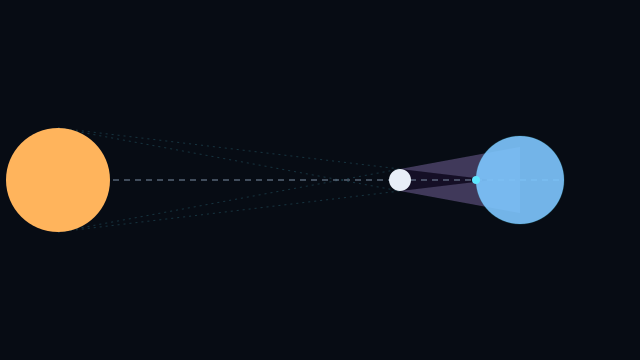
Because at this eclipse the Moon happens to look slightly bigger than the Sun. Both discs are close to half a degree wide, but both vary — the Moon's apparent radius by about a seventh over a month — and the two ranges overlap. When the Moon is near enough, its shadow cone still has length to spare when it arrives and the tip lands on the ground: a total eclipse. When it is not, the cone runs out short of the surface and the same alignment gives an annular eclipse instead, with a ring of photosphere left over. There is nothing in between except the hybrid case, which is both at different points along one track.
What makes it different
Every other kind of solar eclipse is a subtraction of sunlight. A total eclipse is a change of sky. For the duration of totality the Sun's disc is gone entirely, the corona appears, the brighter planets and stars come out, the horizon takes on the colours of a sunset in every direction at once, and the temperature drops.
None of this happens at 99% obscuration. The remaining sliver of photosphere is thousands of times brighter than everything the eclipse would otherwise reveal.
Why it is rare where you are
Total eclipses are not rare — there is one somewhere on Earth roughly every eighteen months. What is rare is one passing over any particular place, because the track is typically one to three hundred kilometres wide and the Earth is mostly ocean. For a given spot the average wait is several centuries. Totality itself lasts two to four minutes on the centre line of a typical eclipse, and never more than about seven and a half.
Only during the total phase itself is it safe to look without a filter, and only then. The partial phases either side are as dangerous as an ordinary Sun. If any part of the photosphere is showing, use certified eclipse filters.
Related
Updated 13 August 2026. The dates and durations on this page are recomputed with every weekly rebuild.