EN ▾
Annular eclipse — when a ring of Sun is left showing
In an annular eclipse the Moon crosses the middle of the Sun but is too far away to cover it, leaving a ring of photosphere. Never safe to view unaided.
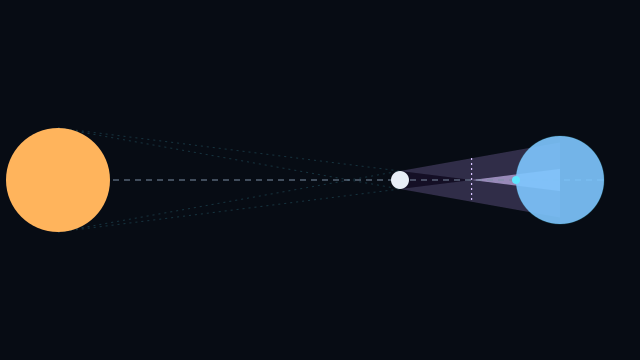
In an annular eclipse the Moon passes across the middle of the Sun — a central eclipse, the same alignment as a total one — but is too far from the Earth to cover it. A ring of photosphere is left showing all the way round. It is a perfect ring only on the centre line; off it the Moon sits off-centre and the ring is visibly thicker on one side. The next one is on 6 February 2027.
Why the Moon is sometimes too small
The Moon's orbit is not a circle. Its apparent radius runs from 14.7′ to 16.7′ over a month — a swing of about a seventh — while the Sun's runs from 15.8′ to 16.3′ over a year. The two ranges overlap, which is why both kinds of central eclipse exist at all.
The crossover is nearer than most people guess. The Moon's shadow cone reaches the Earth's surface only while the Moon is within roughly 380,000 km, and its mean distance is 384,400. So the Moon is too small rather more often than not: annular eclipses outnumber total ones, 33% of all solar eclipses against 27%. A total eclipse is the one that needs luck.
Why it is not a lesser total eclipse
It is a different event, and the difference is not one of degree.
- The sky does not go dark. A ring of photosphere is a great deal of Sun, and full daylight is never really lost.
- The corona is not visible, and neither are the stars.
- The magnitude never reaches 1 — it typically peaks around 0.94 — so obscuration never reaches 1 either, peaking at roughly 0.85 to 0.95. Around a tenth of the Sun is still shining at the deepest moment.
There is no moment in an annular eclipse at which it is safe to look without a filter. Not at maximum, not for a second. This is the most consequential difference from a total eclipse, and the one most often got wrong.
Related
Updated 13 August 2026. The dates and durations on this page are recomputed with every weekly rebuild.