EN ▾
Greatest eclipse — the one instant the whole planet shares
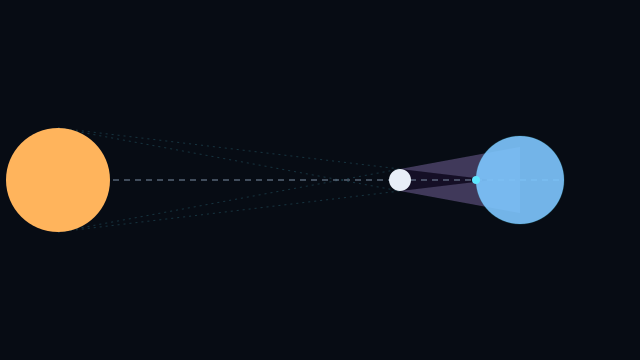
Greatest eclipse is the moment the shadow axis passes closest to the Earth's centre — one instant for the whole world, and what an eclipse is dated by.
Greatest eclipse is the instant at which the shadow axis passes closest to the centre of the Earth. It is a single moment for the entire planet — the one time associated with an eclipse that is not an observer's own.
Why an eclipse is dated by it
The four contacts are local, so they cannot name an event. Greatest eclipse can, and does: when this site says an eclipse is on 2 August 2027, that is the UTC date of greatest eclipse. Every eclipse page and every URL on this site is keyed to it.
It also fixes the reference point for the geometry. For a central eclipse the latitude and longitude quoted are the ground point directly under the axis at that instant — the place where the eclipse is, in the sense of being most nearly overhead. A partial-only eclipse still has a moment of greatest eclipse, because the axis has a closest approach whether or not it lands; it simply has no ground point of its own.
Not the same as the "maximum" in the timings panel
These are different quantities and the app shows both. Greatest eclipse belongs to the planet. Maximum, in the timings panel and the eclipse lists, is your deepest moment at your coordinates, and for almost every location it falls at a different instant. If you are a thousand kilometres off the track, your maximum may be an hour from greatest eclipse.
Not quite the same as greatest duration
The point of greatest eclipse and the point of longest totality are close together but not identical, and how far apart varies a great deal between eclipses — in 2017 the two were roughly a hundred kilometres and several minutes apart. Greatest eclipse is defined by the axis and the Earth's centre; greatest duration is width divided by speed, so it depends additionally on how wide the umbra is at that point and how fast it is moving over the ground, both of which change along the track.
For most purposes the distinction does not matter. It matters if you are choosing a spot on the centre line for the longest possible view, in which case the app's per-location timings are the thing to trust rather than the headline point.
Related
Updated 13 August 2026. The dates and durations on this page are recomputed with every weekly rebuild.