EN ▾
How an eclipse is predicted
Two analytic series for the positions of the Sun and Moon, a geometric test for whether the shadow reaches the ground, and a root-find for the moments the discs touch.
Every time and every track on this site is computed rather than copied from a table. The machinery has three parts, and none of them is complicated on its own.
Where the Sun and Moon are
The positions come from analytic ephemeris series — long sums of periodic terms, each with an amplitude and a frequency, fitted to the gravitational theory of the solar system. Evaluating one at an instant gives the Sun's or the Moon's position directly, with no need to integrate an orbit forwards from a starting state.
That is what makes a site like this possible. A numerical integration would have to be run once, centrally, and its results shipped as a table; a series can be evaluated in a browser, for an arbitrary instant, in microseconds. It is also why the range here is fifty years and not five thousand: the series are truncated, and their accuracy degrades gracefully but really does degrade.
Whether there is an eclipse at all
An eclipse needs the Moon between the Earth and the Sun — a syzygy — and needs the alignment to be close enough. The test is the angular separation of the two centres as seen from the Earth: when it falls below the sum of the apparent radii, somewhere on Earth sees the discs overlap.
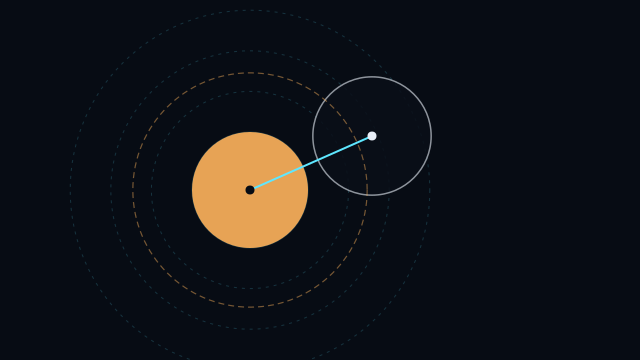
Whether that overlap is total anywhere is a different question, and it is answered by the shadow axis: the line from the Sun's centre through the Moon's. If that line meets the Earth, the umbra reaches the ground and the eclipse is central somewhere along a track. If it passes above or below, every observer sees a partial eclipse and no more.
When the discs touch
The contacts — the four moments the limbs meet — are found by root-finding rather than by formula. The separation of the two centres, as seen from one point on the ground, is a smooth function of time; a contact is where it crosses the sum or the difference of the radii, and a bracketed search converges on it to a fraction of a second in a few dozen evaluations.
Doing this per observer is what makes local times local. The contacts differ by minutes across a country because they are a property of a place and an instant, not of the eclipse.
Two radii, not one
A detail that is invisible until it is wrong: the exterior contacts and the interior ones use different values for the Moon's radius. The convention distinguishes the mean lunar limb from a limb corrected for the mountains and valleys along it, and using one value for all four contacts shifts the beginning and end of totality by a second or two and moves the path limits by about a kilometre. Every published circumstance uses the pair; so does this site.
Related
Updated 25 August 2026.