EN ▾
Syzygy — Sun, Moon and Earth in a straight line
A syzygy is an alignment of three bodies. Every new moon is a rough one; only the close ones produce an eclipse, and this app scans for the close ones.
A syzygy is an alignment of three bodies in a straight line. For solar eclipses that means Sun, Moon and Earth, in that order — which happens every lunation, at every new moon.
The word covers the other alignment too. At full moon the Earth sits between the Sun and the Moon, and that is equally a syzygy; it is where lunar eclipses come from. This site is about solar eclipses, so syzygy here always means the new-moon one, but the term itself is not restricted to it.
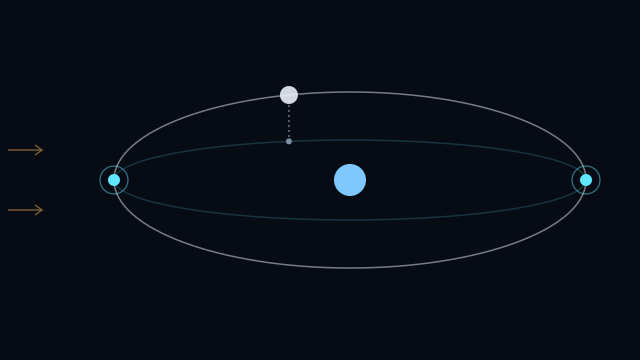
Rough alignments and close ones
"In a straight line" is doing a lot of work. The Moon's orbit is tilted about 5.1° to the ecliptic, so at most new moons the Moon passes several degrees above or below the Sun — an enormous distance when the discs are only half a degree wide.
The alignment is close enough for an eclipse only when the new moon happens near a node. That is the whole reason there is not an eclipse every month.
How this app uses the word
The eclipse scan works by finding near-syzygies first: every new moon within 3° of the Sun, which is comfortably wider than the penumbra ever reaches. That produces a list of candidates, most of which turn out to be near-misses. Each candidate is then resolved properly to see whether any part of the shadow actually meets the Earth.
Doing it in two stages is what makes a fifty-year scan fast enough to run in a browser: the cheap test rejects almost everything, and the expensive one runs only on what survives.
Related
Updated 13 August 2026.