EN ▾
Penumbra — the partial shadow, thousands of kilometres wide
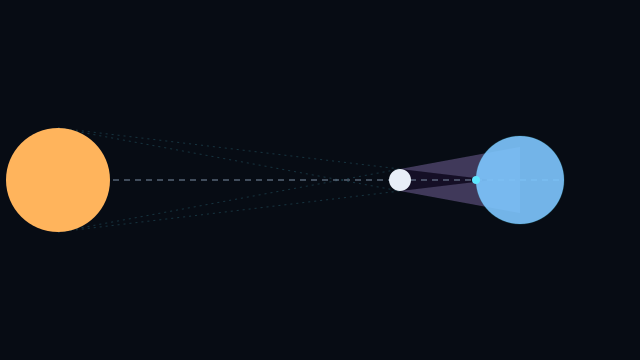
The penumbra is the region around the umbra from which part of the Sun is hidden. It spans continents, which is why partial eclipses are common.
The penumbra is the region of partial shadow surrounding the umbra, within which some but not all of the Sun's disc is blocked. Anyone inside it sees a partial eclipse.
The scale difference is the whole point
The umbra at the Earth's surface is at most 270 km across. The penumbra is around 7,000 km — more than half the planet's diameter. That ratio, about twenty-five to one, is why:
- a partial eclipse is visible across whole continents while totality is confined to a ribbon;
- most people have seen several partial eclipses and no total ones;
- an eclipse "visible from Britain" almost always means the penumbra passed over, not the umbra.
Its edge is where an eclipse stops existing
The outer boundary of the penumbra is where the Moon's limb is exactly tangent to the Sun's — first contact for an observer standing there. Obscuration falls to zero at that line, which is exactly the problem with drawing it: a contour at zero is asymptotic, and no sampling grid can resolve where an infinitesimal nick of the Sun begins. So the app draws the 0.5% contour instead — the same figure the countries panel uses to decide whether a country is touched at all. The two agree by construction, so a country shaded on the map is a country in the list.
Two honest qualifications. The line is a practical proxy for the penumbra's edge, not the edge itself. And the curve the globe draws is clipped to where the Sun is actually above the horizon, so the stretches marked at sunrise and sunset are a rise/set boundary rather than a shadow one.
Inside the line, obscuration climbs continuously from that 0.5% all the way to 1 at the umbra's edge. There is no step anywhere: "in the penumbra" covers everything from an unnoticeable nick to a 99% crescent that still, as partial eclipse explains, does not look like much.
Related
Updated 13 August 2026.