EN ▾
Eclipse season — the window when eclipses are possible
An eclipse season is the roughly 35-day window, twice a year, during which the Sun is near enough to a node for eclipses to happen at all.
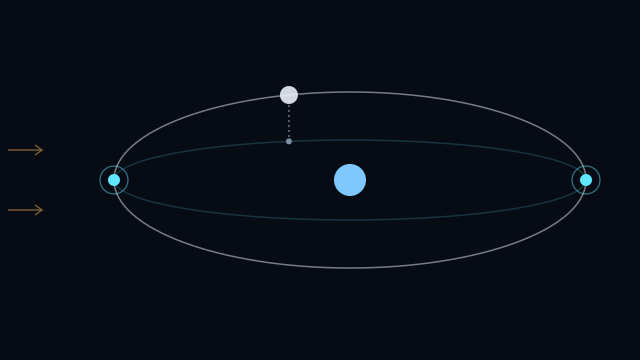
An eclipse season is the window of about 35 days, twice a year, during which the Sun is close enough to one of the Moon's nodes for a solar eclipse to be possible. Outside it, no alignment of the phases can produce one.
The 35 days is the Sun's crossing time through the 18.5° either side of a node within which the discs can touch at all. The window for a central eclipse is tighter — 15.4°, which the Sun clears in about thirty days.
What follows from the length
Even the shortest eclipse season is longer than a lunation's 29.53 days, which has two consequences worth knowing:
- Every eclipse season contains at least one solar eclipse, because at least one new moon is guaranteed to fall inside the window.
- Some contain two, one at each end, if a new moon lands near each edge. Both are then partial, since neither is well centred on the node.
That guarantee does not extend to central eclipses. Their thirty-day window is shorter than a lunation, so a season can pass with only a partial eclipse in it and no path anywhere on Earth — which is the ordinary reason a year goes by without a total eclipse.
The minimum number of solar eclipses in a year is two and the maximum is five, and the five-case requires the seasons to fall so that one year catches three of them. Lunar eclipses have their own, slightly narrower seasons inside the same windows, which is why solar and lunar eclipses arrive in pairs a fortnight apart.
Why they come round more often than twice a year
The nodes drift westwards, completing a circuit in 18.6 years, so the Sun reaches one slightly sooner each time. Successive eclipse seasons are 173.3 days apart rather than half a year, which means they creep backwards through the calendar by about 18.6 days a year. An eclipse season in August will be in mid-July a year later.
Related
Updated 13 August 2026.