EN ▾
How often do solar eclipses happen?
Two to five a year worldwide, which sounds frequent until you ask about one place — where totality comes round about once every 375 years. Both numbers follow from the same geometry.
There are between two and five solar eclipses a year, worldwide. Any given place on Earth sees a partial one every couple of years and a total one roughly once every 375 years. Both numbers are consequences of the same fact, and the gap between them is the whole story.
Why not once a month
The Moon passes between the Earth and the Sun every lunation — about every 29.5 days — so on the face of it there should be an eclipse every new moon. There is not, because the Moon's orbit is tilted about 5.1° to the ecliptic. Most new moons the Moon passes above or below the Sun, missing it by up to ten solar diameters.
An eclipse needs the new moon to fall near a node, one of the two points where the tilted orbit crosses the ecliptic. That happens during an eclipse season, which comes round roughly every 173 days.
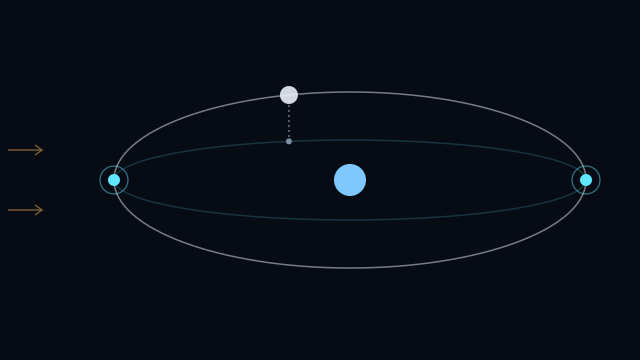
Why 173 days and not six months
The nodes do not stay put. They regress westward around the ecliptic, completing a circuit in 18.6 years, so the eclipse seasons arrive about twenty days earlier each year. That is why eclipse dates drift steadily backwards through the calendar rather than recurring on the same day.
Two eclipse seasons fit inside a year with room to spare, which is where "two to five" comes from: two is the minimum, and five requires a season falling early enough in January for a third to land in December.
Why one place waits centuries
A total eclipse is total only where the Moon's umbra actually touches the ground, and the umbra is small — a couple of hundred kilometres across at best, often much less. The Earth's surface is 510 million square kilometres, and one eclipse track sweeps perhaps 10 million of it.
So the arithmetic is unforgiving: with about 66 total eclipses a century, each covering roughly 2% of the planet, a given point is inside a track about 1.3 times per five centuries. The figure quoted is an average and it hides enormous variance — the tracks are not distributed politely. Carbondale, Illinois had two in seven years; large parts of the world will not see one this millennium.
The pattern underneath
Eclipses are not random. A saros is 6,585.32 days — 18 years, 11 days and 8 hours — after which the Sun, Moon and nodes return to very nearly the same arrangement and a very similar eclipse recurs, about a third of the way west. Every eclipse belongs to a saros series, and every page on this site names which.
Related
Updated 25 August 2026.