EN ▾
Saros — the 6,585-day cycle that repeats an eclipse
The saros is a period of about 18 years 11 days after which a very similar eclipse recurs, a third of the way west. A specific interval, not a generic cycle.
The saros is a period of 6,585.32 days — 18 years, 11 days and 8 hours — after which the Sun, the Moon and the nodes return to very nearly the same arrangement, and a very similar eclipse occurs.
Why it works
Three separate cycles come out very nearly whole in the same number of days:
| Cycle | Length | 6,585.32 days is |
|---|---|---|
| Lunation, new moon to new moon | 29.5306 d | 223.000 |
| Draconic month, node to node | 27.2122 d | 241.999 |
| Anomalistic month, perigee to perigee | 27.5545 d | 238.993 |
The first two mean the geometry of the alignment repeats: a new moon, and at the same distance from the node. The third means the Moon is at nearly the same distance from the Earth, so a repeat is usually the same kind of eclipse as its predecessor.
Note how much looser the third fit is than the other two — 239 anomalistic months overshoot a saros by about five hours, against three quarters of an hour for the draconic. That slack is why "the same kind" holds from one member to the next but not across a whole series: the Moon's distance creeps, and a series that begins with annular eclipses can end with total ones.
The extra third of a day
6,585.32, not 6,585. That leftover third of a day means the Earth has turned nearly an extra 120° by the time the next eclipse in the series arrives, so it lands about a third of the way around the world to the west. Three saroses — 54 years and a month, the exeligmos — bring it back to roughly the same longitude, the small shortfall each time being why "roughly" is the right word. By then the observer who saw the first one is unlikely to be available.
The 18 years and 11 days holds when four leap days fall inside the interval; when five do, it is 18 years and 10 days. The eight hours are constant.
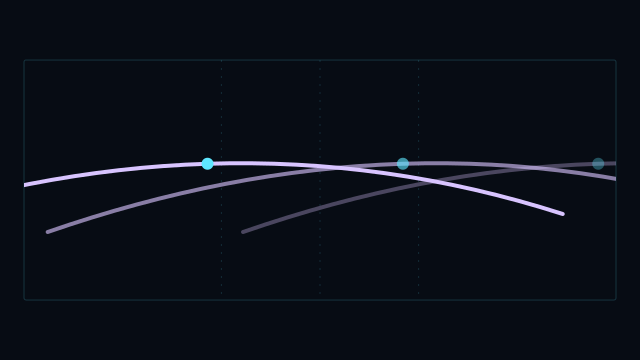
A saros is one specific interval, not a word for "cycle" in general. An eclipse belongs to a numbered saros series of 69 to 87 eclipses, running for twelve to fifteen centuries as the alignment drifts slowly through the node and out the other side — each member falling a little further north or south than the last until the shadow misses the Earth entirely and the series ends. This app can draw the tracks of the neighbouring members one and two periods either side.
Related
Updated 13 August 2026.