EN ▾
Lunation — one cycle of the Moon's phases
A lunation is the 29.53 days from one new moon to the next. Solar eclipses can only happen at new moon, so eclipses are counted in lunations.
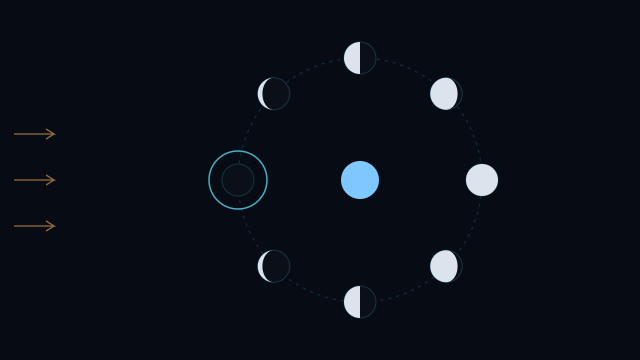
A lunation is one complete cycle of the Moon's phases — new moon to new moon — lasting 29.5306 days on average. It is also called a synodic month.
Why it is longer than an orbit
The Moon completes an orbit against the fixed stars in 27.32 days — the sidereal month — but a lunation takes 29.53. The difference is the Earth's own motion: while the Moon goes round once, the Earth has moved about a thirteenth of the way around the Sun, some 27°, so the Moon has to travel a further two days' worth to line up with the Sun again.
There is a third month worth knowing, because eclipse prediction turns on it: the draconic month, 27.2122 days, from one crossing of a node to the next crossing of the same one. It is shorter than the sidereal month because the nodes themselves drift westwards to meet the Moon. That one, the lunation and the anomalistic month are the three periods whose near coincidence produces the saros.
The mean is not the whole story either. Individual lunations run from about 29.27 to 29.83 days — up to seven hours either side of the average — so counting eclipses forward by 29.5306 days gives the right month and not the right day.
Why this app counts in lunations
Solar eclipses happen only at new moon, so the search space is not "every day for fifty years" but "every lunation for fifty years" — about 620 new moons to examine instead of 18,000 days. Each is tested for how close the Moon passes the Sun, and the great majority are rejected immediately; the ones that survive become the syzygy candidates the scan then resolves properly. That indexing is what makes a fifty-year scan take seconds rather than minutes.
Related
Updated 13 August 2026.