EN ▾
Node — where the Moon's orbit crosses the ecliptic
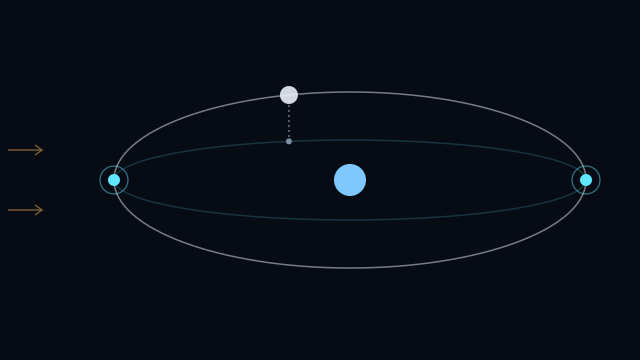
The nodes are the two points where the Moon's orbit crosses the ecliptic. Eclipses happen only near them, which is why there is not one every month.
The nodes are the two points at which the Moon's orbit crosses the plane of the ecliptic. The ascending node is where it crosses going north, the descending node where it crosses going south.
Why there is not an eclipse every month
This is the question the nodes answer. The Moon's orbit is tilted 5.1° to the Earth's, so for most of each month the Moon is above or below the plane the Sun sits in. At a typical new moon it passes the Sun by about three degrees — six or seven times the width of either disc, and up to ten times at the extreme — and nothing happens.
A solar eclipse needs a new moon and the Moon near a node at the same time. Those two cycles have different lengths, so they drift in and out of step, and the times when they coincide are the eclipse seasons.
They move
The nodes are not fixed. Dragged on by the Sun's gravity, they drift westwards around the orbit, completing a circuit in about 18.6 years. That regression is why eclipse seasons come round slightly more often than twice a year — every 173.3 days rather than every 182.6.
It is also why the Moon takes less time to return to a node than to return to the same star: the node comes to meet it. That interval is the draconic month, 27.2122 days, and it is one of the three periods whose near coincidence produces the saros — the regression itself is the cause of it rather than a fourth member of the set.
How near is "near a node"
Near enough that the discs can touch. A solar eclipse of some kind is possible while the Sun is within about 18.5° of a node, and a central one while it is within about 15.4°. The two nodes sit exactly opposite each other, 180° apart, which is why the seasons come in a pair.
Related
Updated 13 August 2026.