EN ▾
Ecliptic — the plane of the Earth's orbit
The ecliptic is the plane the Earth orbits the Sun in, and so the path the Sun appears to trace against the stars. It is named after eclipses.
The ecliptic is the plane of the Earth's orbit around the Sun. Seen from the ground it is the line the Sun appears to trace against the background stars over the course of a year, and the band the planets and the Moon are always found close to.
The name
The ecliptic takes its name from eclipses, not the other way round. Eclipse is the older word — Greek ekleipsis, a failing or abandonment — and the circle was named after the events that happen along it: Late Latin linea ecliptica, the line of eclipses.
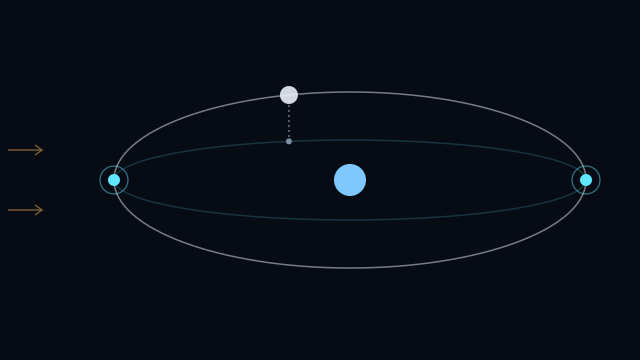
That name is earned. An eclipse needs two things at once: the Sun is always on the ecliptic, so the Moon must be there too, which happens only at a node — and it must be at that node at new moon rather than at some other point in the month. Either condition alone is common; together they are not.
Why everything in the solar system is near it
The planets orbit within a few degrees of the same plane because they condensed from a single rotating disc. The Moon is a partial exception: its 5.1° tilt is large enough to prevent monthly eclipses, and small enough that eclipses happen at all. A steeper tilt would make them rare; a flatter one would make them monthly and unremarkable.
This app's heliocentric view is drawn looking down on this plane, which is why the planets' orbits appear as near-circles rather than as ellipses seen at an angle.
The Earth's own axis is tilted 23.4° to it — the obliquity, which is what gives us seasons and what makes the ecliptic ride high in the sky in winter and low in summer. That tilt has nothing to do with eclipses; the 5.1° one does all the work here.
Related
Updated 13 August 2026.